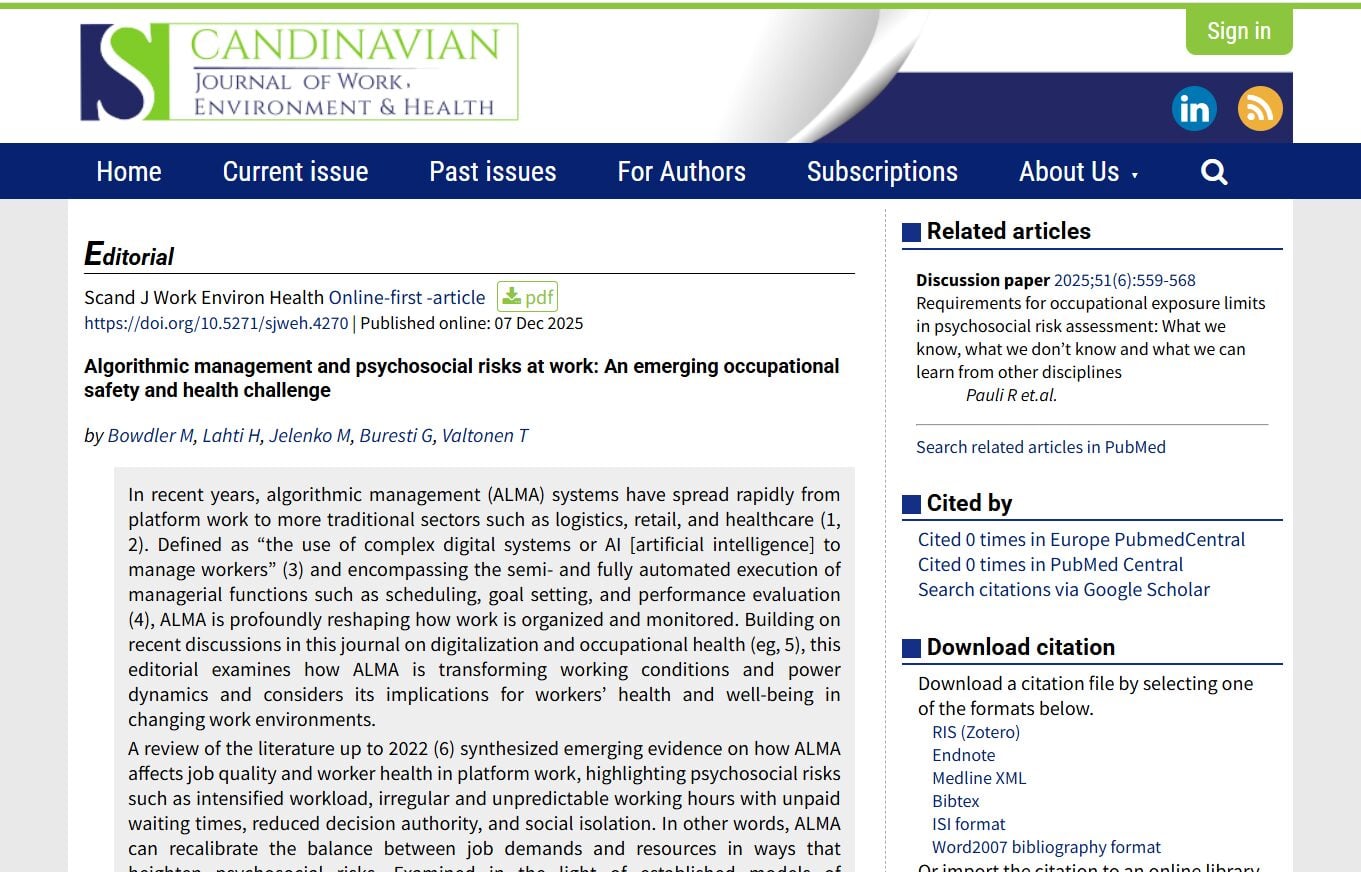
The recent editorial in the Scandinavian Journal of Work, Environment & Health (https://www.sjweh.fi/article/4270) calls for a renewed focus on job design as a cornerstone of worker health and well-being. It emphasizes that creating healthier workplaces requires balancing job demands with resources, fostering autonomy, and embedding preventive strategies into organizational structures.
This perspective resonates strongly with the ALMA-AI project led by PEROSH, which explores how algorithmic management and AI-based systems are reshaping work organization and impacting occupational safety and health (OSH). The project brings together 16 researchers from 8 institutes across Europe to examine psychosocial risks, job quality, and opportunities for healthier work environments in a digitalized world.
Key insights from ALMA-AI include:
- Understanding algorithmic management: How AI-driven systems influence autonomy, workload, and trust.
- Psychosocial risk factors: Intensification of work, loss of job control, and social isolation.
- Evidence-based recommendations: For integrating AI responsibly into work design to protect health and well-being.
Both the editorial and ALMA-AI underline a common message: technology and health must go hand in hand. As workplaces evolve, proactive design and collaborative research are key to ensuring that innovation supports—not undermines—human well-being.
👉 Read the editorial here: https://www.sjweh.fi/article/4270
👉 Learn more about ALMA-AI and PEROSH’s work: PEROSH Projects