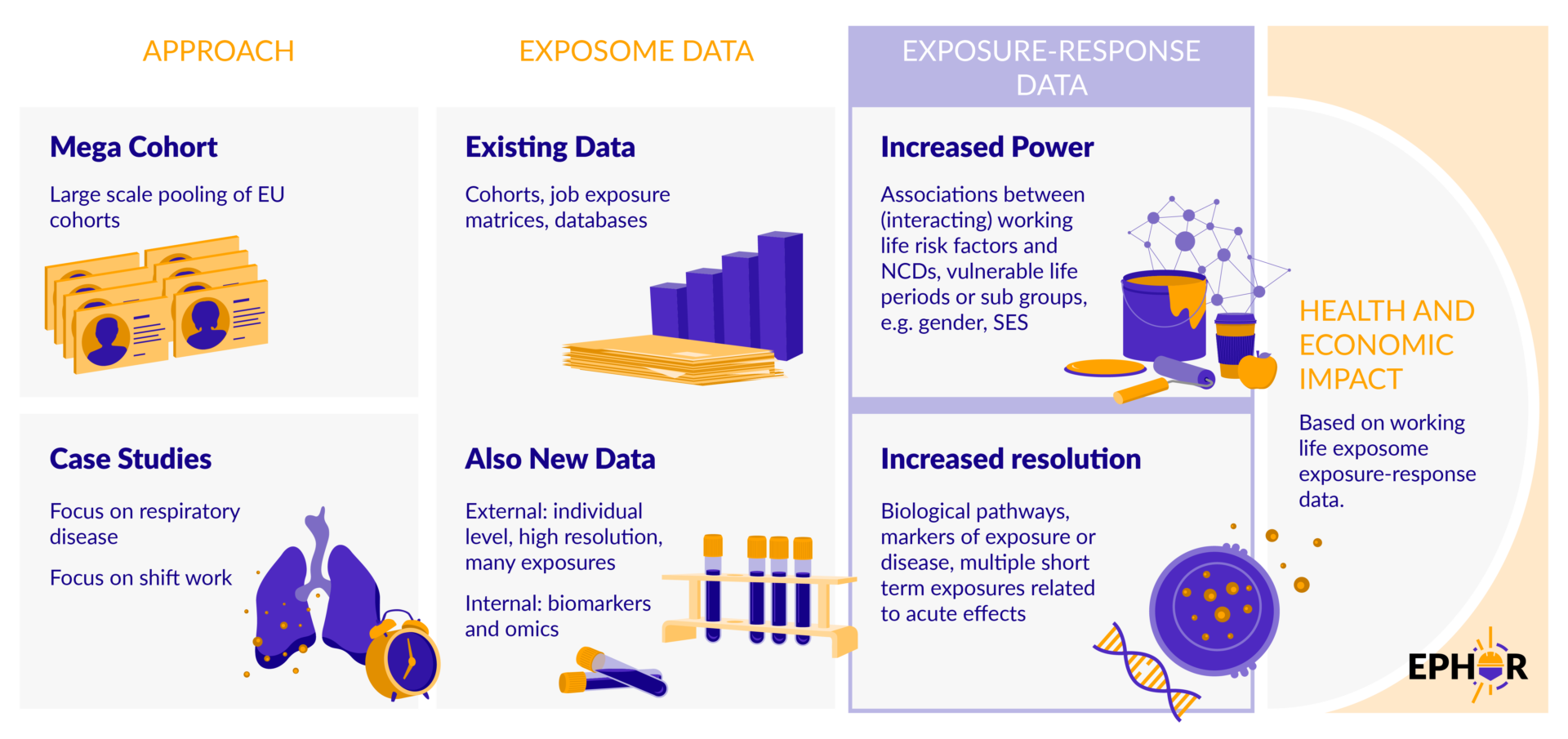
The EU’s EPHOR project (2020-2025, 20 partners) has broken new ground in occupational health research by applying the working life exposome concept. The project combined two strategies: 1) harnessing the power of existing European cohort data and 2) conducting intensive, real-world exposome data collection in targeted case studies (night shift and respiratory health). The project led to the creation of the WE-EXPOSE Toolbox—a practical, science-based resource for researchers, policymakers, and occupational health professionals.
Cohort-Based Insights EPHOR tapped into the valuable resource of existing European cohorts with occupational histories. The development of EuroJEM—a job exposure matrix covering chemical, ergonomic, psychosocial, physical, and biological risks-, advanced analytics and AI driven job coding, enabled researchers to explore complex relationships between the working life exposures and cancer, cardiometabolic, mental, respiratory, neurodegenerative and musculoskeletal disease, and work participation.
Intensive exposome data collection. Two case studies collected granular data using e.g. wearable sensors, physiological assessments, and multi-omics profiling. The night shift work study among over 900 workers across four countries demonstrated clear associations with adverse health outcomes through multiple biological pathways. The respiratory health study among 150 mild asthma cases revealed associations between the short-term exposome and cross-week change in lung function.
WE-EXPOSE Toolbox To ensure key results are accessible by policymakers, occupational safety and health (OSH) professionals, and researchers, the WE-EXPOSE Toolbox is now fully available. The Toolbox contains all methods, protocols, and results, including an interactive explorer of the prevalence of occupational exposures across Europe, sensor use guidance for occupational exposure assessment and workflows for exposome based health impact assessments. Co-created with occupational health stakeholders, it provides the basis for innovating occupational health research as well as evidence-based policies and OSH practices.
PEROSH contributions Four PEROSH partners participated in the EPHOR project. TNO was the project coordinator and responsible for tool and toolbox development. STAMI led the cohort based approach. FIOH developed methods on working life expectancy. NFA was a major contributor to the shift work case study. In addition all four institutes contributed to EuroJEM and performed analyses on the occupational exposome in relation to non-communicable disease.
Related institutes:
TNO, STAMI, FIOH, NFA
Contact information:
Author(s): A. Pronk (TNO), I.S. Mehlum (STAMI), S. Solovieva (FIOH), A.H Garde (NFA)
More information: anjoeka.pronk@tno.nl
Source/Copyright Holder image: Infographic developed as part of the EU EPHOR project, copyright owned by TNO