Background
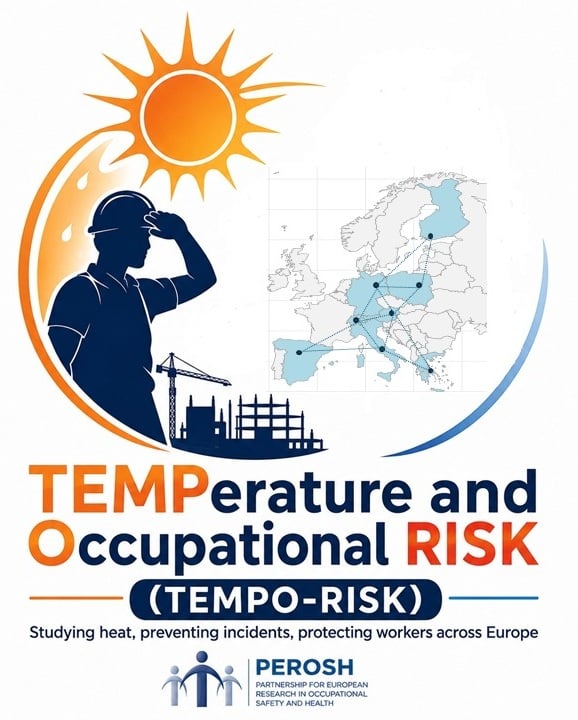
Temperatures across Europe and the Mediterranean basin are steadily increasing. Rising temperatures have been shown to adversely affect human health in terms of both mortality and morbidity, with impacts varying by age, sex, and socioeconomic characteristics. A growing body of evidence is emerging on the effects of climate change on the occupational health and safety, with negative consequences for work capacity, and social costs. Some studies have investigated the association between extreme temperatures and occupational injuries, but a comprehensive assessment at the European level is still lacking. Heterogeneity across countries remains largely unknown.
Objectives
To provide a comprehensive assessment at the European level of the effects of exposure to extreme heat on the risk of occupational injury, by country, employment sector, and job task, identifying the exposure–response functions across countries and estimating the attributable number and fraction of heat-related occupational injuries.
Target groups
This project targets workers, occupational safety and health professionals, researchers, policy makers, workers and employers. who are particularly exposed to heat, employers. The increased awareness of heat-related risks in the occupational context may support the adoption of workplace mitigation and adaptation strategies. The project findings can inform public health interventions and high-temperature warning systems aimed at identifying geographical areas and periods associated with health and safety risk for workers.
Deliverables
The main deliverable will be a report on the risk of occupational injury associated with occupational exposure to extreme heat, both overall and by geographical area, identifying heterogeneity in the main vulnerability factors. A p+ublished study on a peer review journal reporting the overall exposure–response functions and by the involved countries, the attributable number and the fraction of heat-related occupational injuries. A workshop with the findings presentation and discussion.
Research methods
Information on occupational injury recognized systems in each participating country will be collected through a questionnaire and, where possible, harmonized in terms of common variables and temporal coverage. Individual-level data on occupational injuries occurring in representative cities in each participating country will be collected and harmonized according to the project variables. Time series of daily counts of occupational injuries at the city level will then be derived. Ambient exposure variables will be obtained from the available European archives. An epidemiological study will subsequently be conducted at the city level, using time-series analysis based on Poisson regression models, to assess the association between heat and occupational injuries. Results will then be pooled by means of meta-analysis to derive exposure–response functions at the country and European levels. Finally, the attributable number and fraction of heat-related occupational injuries will be estimated.
Scientific relevance
The effects of climate change on occupational health and safety have been identified as one of the emerging challenges in occupational medicine and epidemiology. Europe and the Mediterranean region are particularly affected by climate change, with temperatures increasing over time. Outdoor workers and those employed in specific economic sectors may be exposed to hot conditions that can increase the risk of injuries and other adverse health effects. Information on heat-related risk profiles may support the identification of risk thresholds above which mitigation strategies should be implemented to reduce health impacts. Although a few European studies have assessed this risk in selected countries, an overall picture is still lacking. Differences in occupational, meteorological, and climatic conditions may contribute to heterogeneity in risk profiles and related impacts across European geographical areas.
Practical and societal relevance
The project results will support the mitigation and adaptation policies for contrasting the climate change effects on health. The identification of country-specific profiles may inform the planning of targeted workplace mitigation measures, as well as public health interventions and warning systems.
Project leaders
Alessandro Marinaccio (Inail, Italy), a.marinaccio@inail.it
Claudio Gariazzo (Inail, Italy), c.gariazzo@inail.it
Project participants
The project includes participants from various PEROSH partner institutions:
- Agata Kmiecik, CIOP
- Poland Irina Guseva-Canu, Unisanté, Switzerland
- Pia Pertulla, FIOH, Finland
- Veronika Sturzlinger, AUVA, Austria
- Angelika Hauke, IFA, Germany
- Alicia Guzmán and Laura Rodríguez, INSST, Spain
- Theoni Koukoulaki, ELINYAE, Greece